



Breaking Free from Import Dependence: How Local Assembly Transforms Your Energy Business
For businesses selling solar and energy storage solutions in developing markets, import dependence creates persistent challenges. Every shipment carries risks: container delays at congested ports, sudden tariff increases, currency fluctuation impacts, and the constant pressure to maintain inventory levels that tie up working capital.
Local assembly of energy storage systems offers a fundamentally different operating model—one that reduces risk, improves cash flow, and creates competitive advantages that pure importers cannot match.

The Hidden Costs of the Import Model
Most energy storage businesses begin by importing fully assembled systems from Chinese manufacturers. This model appears straightforward, but it carries significant hidden costs:
Inventory carrying costs are often underestimated. When you import finished goods, you must forecast demand months in advance, place large container-sized orders, and hold inventory until it sells. Working capital gets tied up in slow-moving SKUs while fast-moving products run out.
Obsolescence risk increases with inventory levels. Battery technology evolves rapidly; products sitting in warehouses for six months may lose competitive edge before they reach customers.
Logistics complexity adds management burden. International shipping, customs clearance, and inland transportation require coordination across multiple vendors, creating opportunities for delays and cost overruns.
Tariff exposure can change unexpectedly. Trade policies shift, and import-dependent businesses have no control over the duties they must pay.
Local assembly transforms these fixed costs into variable costs aligned with actual sales.
The ONESUN Local Assembly Advantage
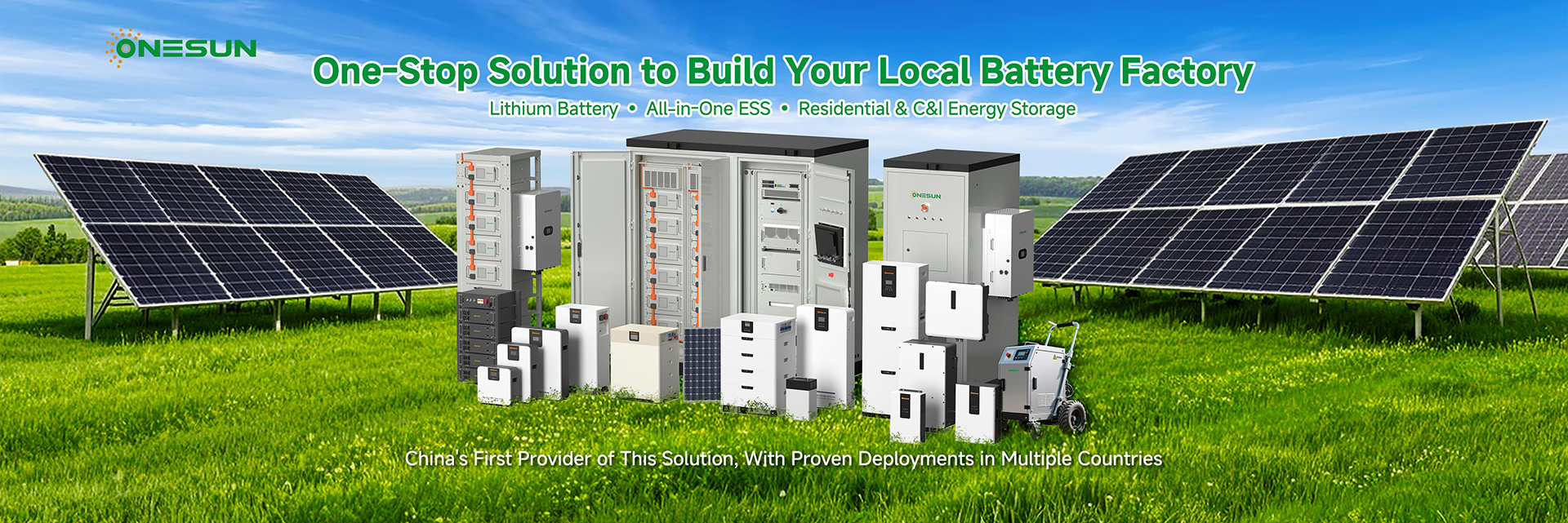
ONESUN’s agile factory model enables local partners to assemble complete energy storage systems from semi-knocked-down (SKD) components. The process is simpler than many imagine:
Components arrive as kits containing everything needed for assembly: Grade A LiFePO₄ cells, battery management system (BMS) boards, enclosures, wiring harnesses, and inverters. Local technicians assemble these components into finished products following ONESUN’s standardized procedures, with quality control protocols ensuring every unit meets specifications.
This approach offers several advantages over full-system import:
Lower working capital requirements. Instead of importing finished goods, you import components as orders are placed. Component costs are lower, and you can maintain smaller inventories of finished goods.
Greater product flexibility. With local assembly, you can configure products to meet specific customer requirements rather than offering only standard configurations. Need a custom voltage for a commercial project? Want to offer private-label branding? Local assembly makes these capabilities practical.
Faster response to market changes. When a new product feature becomes important or a competitor introduces a new specification, local assembly allows you to adapt quickly rather than waiting months for the next container shipment.
Building Technical Capability
A common concern about local assembly is whether local teams can develop the technical expertise to produce reliable products. ONESUN addresses this through comprehensive technology transfer programs.
Our technicians travel to partner facilities to establish assembly lines, train local staff, and implement quality systems. We provide detailed assembly manuals, testing procedures, and ongoing technical support. Partners gain not just a manufacturing capability but also genuine technical expertise in lithium battery systems.
This capability building has lasting value. Partners who develop battery assembly skills can expand into related areas like electric vehicle battery packs, telecom backup systems, and custom energy storage solutions—opening new revenue streams beyond the initial product line.
Certifications That Matter
ONESUN’s components come with the certifications required for global markets: UN38.3 for transportation safety, CE for European market compliance, and UL-compliant designs for North American applications . When you assemble locally using ONESUN components, your finished products inherit these certifications, simplifying market access.
This matters because customers increasingly demand certified products. Governments require certified equipment for public projects. Insurance companies require certified installations. End users want assurance that their investment is safe and reliable.
Scaling with Market Growth
The ONESUN partnership model scales naturally with market development. Early-stage operations might assemble 50-100 units monthly, sufficient to serve residential and small commercial markets. As demand grows, production capacity can expand without major capital reinvestment.
This scalability is particularly valuable in emerging markets where growth trajectories are uncertain. You don’t need to bet big on a factory that may take years to reach capacity. You build capability incrementally, matching production to market demand.
A Partnership for Long-Term Success
The transition from importer to local manufacturer represents a fundamental business transformation. It shifts your company from being a distributor of others’ products to being a producer with genuine manufacturing capability.
ONESUN’s role is to make this transformation as smooth and successful as possible. We bring technical expertise, quality components, and proven systems. You bring local market knowledge, customer relationships, and operational execution. Together, we build a business that serves your market better than any importer could.